When a valued employee asks to go part-time, decide on the work, not the reason. List what the role delivers in a normal week and sort it into work they keep, work that moves to a colleague and work that stops. Ask the colleagues taking the moved work whether they have time for it. Then put the hours, pay, goals, cover and a review date in writing. In Great Britain the request may also be a statutory process with a two-month deadline, so check the rules where the employee works before you reply.
What you'll learn
- Sort the role into work that stays, moves to a colleague or stops.
- Check who covers the moved work before you agree to the new hours.
- Write down hours, pay, goals, cover and a review date before the change starts.
Before you answer a request to go part-time
In the employer half of the same research, 40% of 2,049 senior decision-makers said formal requests for flexible working had increased since the pandemic. Both figures cover every kind of flexible working, not only reduced hours, and describe the UK in early 2023. If the person in front of you found the request hard to make, a clear date for your answer is the first thing they need.
Ask four practical questions: which days or hours they want to work, from when, whether the change is for a fixed period or permanent, and what they think would need to change in their work. You may hear the reason, such as childcare, study, health or a project of their own. You don't need it to decide. If you weigh whose reason sounds more deserving, the next person who asks has no rule to rely on. Use the same test for every request: can the work be arranged around the new hours?
If the request is linked to a health condition or disability, other legal duties may apply. Take advice from an employment specialist before you refuse or delay it.
Map the role before you decide
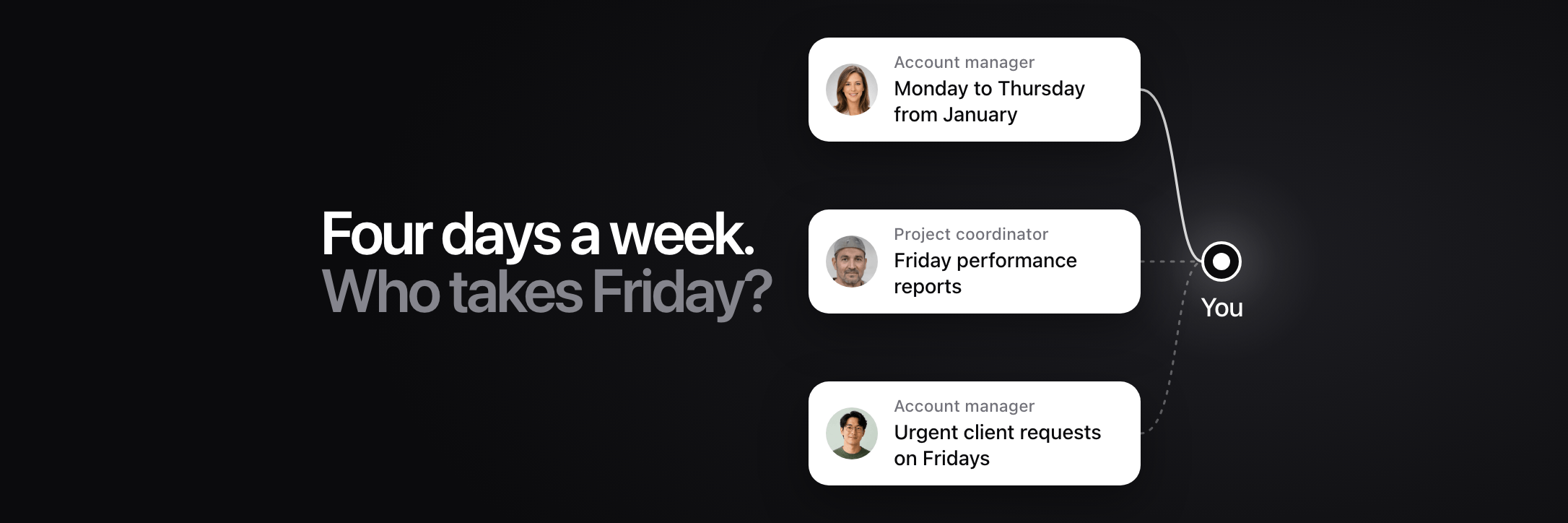
Here is a hypothetical example. Priya, an account manager at a 20-person agency, asks to work Monday to Thursday from January. Her manager lists what she does in a typical week and decides what happens to each part.
| Work in a typical week | What happens to it |
|---|---|
| Client check-in calls | Keep. Friday calls move to Monday to Thursday where the client agrees. |
| Friday performance reports for two clients | Move. Felix, the project coordinator, sends them from a template Priya updates on Thursday. |
| Urgent client requests on Fridays | Move. Julian, another account manager, covers Fridays using a handover note Priya writes on Thursday afternoon. |
| Onboarding junior staff | Pause. The founder takes the next two starters. Review in March. |
| Monthly agency newsletter | Stop. Nobody restarts it until someone has the time and a reason to. |
If most of the role is tied to particular days or hours, such as on-call shifts or a daily customer slot, fewer days may be the wrong shape. Shorter days or a different day off could fit the work better. If nothing in the role can move or stop, you have a staffing problem to settle before you can answer the request.
Check who takes the moved work
In the example, Felix gains two client reports a week and Julian gains Friday cover. Ask each of them what they will pause to make room, and agree it with their manager. Otherwise part of a full-time job lands on people who were already busy. If the team is stretched already, start with what to do when your team has too much work. Where Priya is the only person who knows how some clients like to work, use the handover to write it down. A key person dependency check shows where else knowledge sits with one person.
Put the part-time arrangement in writing
- 01
Hours and start date
Name the days or hours and the date the change starts. If you agree a trial, write how long it lasts and what happens at the end.
- 02
Pay and benefits
Set pay for the new hours and check each benefit. In Great Britain, part-time workers should get the same treatment as full-time colleagues, with some benefits paid pro rata: GOV.UK's example is a £1,000 bonus becoming £500 for someone on half the hours. Elsewhere, check whether eligibility for a benefit depends on hours worked.
- 03
Goals and cover
List the goals that change, who covers on non-working days and where the handover note lives.
- 04
Contact on the day off
Agree whether colleagues may contact them on a non-working day, and for what. “Only if a client campaign fails to launch” is clearer than “only if urgent”. If people keep messaging anyway, the problem looks like an employee who won't take time off: the work has not really moved.
- 05
Review date
Book a review four to six weeks after the start. Bring the role map and check what actually happened.
Decide whether the change is a trial before you agree, not at the review. Acas suggests considering a trial period to test a change. It also notes that an agreed change usually changes the employment contract and can be changed later only if both sides agree. In Great Britain, contract changes must be confirmed in writing within one month of agreeing them. If you want the option to go back, say so in the written agreement.
Tell the team what changes for them: which days the person works, who to contact on the other days and which work has moved. The reason for the request is the employee's to share.
If you can't agree to the request yet
Say what you looked at and where it broke down. For example: “Friday calls can't move for our two retainer clients, and nobody else can take them until the new account manager starts in April.” Then offer what you can: a different day off, shorter days instead of fewer, a later start date or a reduction for an agreed period. In Great Britain, a refusal must follow a consultation and rest on one of the listed business reasons. The Acas Code calls offering an appeal good practice, and any appeal falls inside the same two-month window unless you both agree to extend it.
The employee may be weighing other options after a no. Say what would change your answer and give a date to revisit it, then keep that date. The conversation about telling an employee they are not getting a raise follows a similar structure: what you decided, why, and what would change it.
At the review, go back to the role map you made when they asked to go part-time. Check whether the moved work was done on time, whether anyone worked on their day off and whether the colleagues covering still have room. Fix the part that failed. If you use Cooperly, Fundamentals can help the team discuss who owns the work after the change.