If an employee won't take time off, ask what makes an absence difficult before pressing for dates. They may be worried about a deadline, the work waiting on return, how taking leave will be judged, or something they do not want to discuss. Find out which work arrangement you can change, then make a feasible plan through your normal leave process.
What you'll learn
- Ask about the obstacle without deciding the employee's motive for them.
- Change the workload, contact or return expectation that makes leave difficult.
- Check whether the agreement held, rather than counting a booking as the whole result.
When someone won't take time off, ask what makes it difficult
Raise it in a private one-to-one: 'I've noticed your leave keeps getting postponed. What would make it possible to take some time away?' Listen before offering your explanation. 'You don't trust the team' or 'You need to learn to switch off' can turn a planning problem into a judgment about the person.
If the answer is 'I'm too busy', ask what specifically would go wrong. Is a customer waiting for a decision? Does the employee expect messages throughout the week? Will the same deadline be waiting when they return, with less time to do the work? Use the answer to identify one concrete obstacle rather than collecting a list of personal reasons.
Breathe surveyed 1,000 working adults aged 18 to 65 in the UK through Pollfish on 25 and 26 July 2024. This was a reported worry, not evidence that taking holiday damaged careers. The release gives no separate result for small teams. It is a reason to ask about that concern, not to assume that this employee has it.
Someone may prefer different dates or have no plans they want to explain. They do not need to explain their holiday plans to make the work conversation useful. Ask whether timing, the booking process or expectations about availability are getting in the way. If they raise a personal concern, agree the appropriate private route for support; do not add the explanation to shared team notes.
Make a promise the work can support
- 01
Change the commitment that blocks the dates
Look at the actual work falling before, during and just after the proposed absence. Decide what can stop, move or go to someone else. Confirm a changed customer deadline or internal priority with its owner. 'Finish everything before you go' leaves the original problem with the employee.
- 02
Give the cover person room to act
Agree the necessary work, decision authority and available time with whoever will cover it. Move another commitment if needed. If no suitable person has capacity, you own the decision about scope, timing or additional help; do not leave the employee to recruit a volunteer.
- 03
Set the contact and return expectations
Name the person who handles questions while the employee is away. Explain that routine updates do not require their attention, and do not ask them to monitor a channel just in case. Reserve realistic time on return to hear what changed and decide which outstanding work still matters.
Once someone is available to cover defined work, check what the backup can actually handle. That is a separate preparation task. This conversation establishes whether an absence can be agreed at all; a colleague's name on a plan does not settle it.
If the concern is how leave will look, answer with your own behaviour. Stop praising people for cancelling holidays or answering from leave. When discussing performance, use the agreed work expectations and check whether you have set deadlines that depend on constant availability. A reassuring sentence followed by an unchanged expectation gives the employee little reason to believe the sentence.
If no week is workable because the team has more commitments than it can meet, use the team overload guide to make a capacity decision. Repeatedly postponing one person's leave keeps that decision unresolved.
Work through a week that keeps being postponed
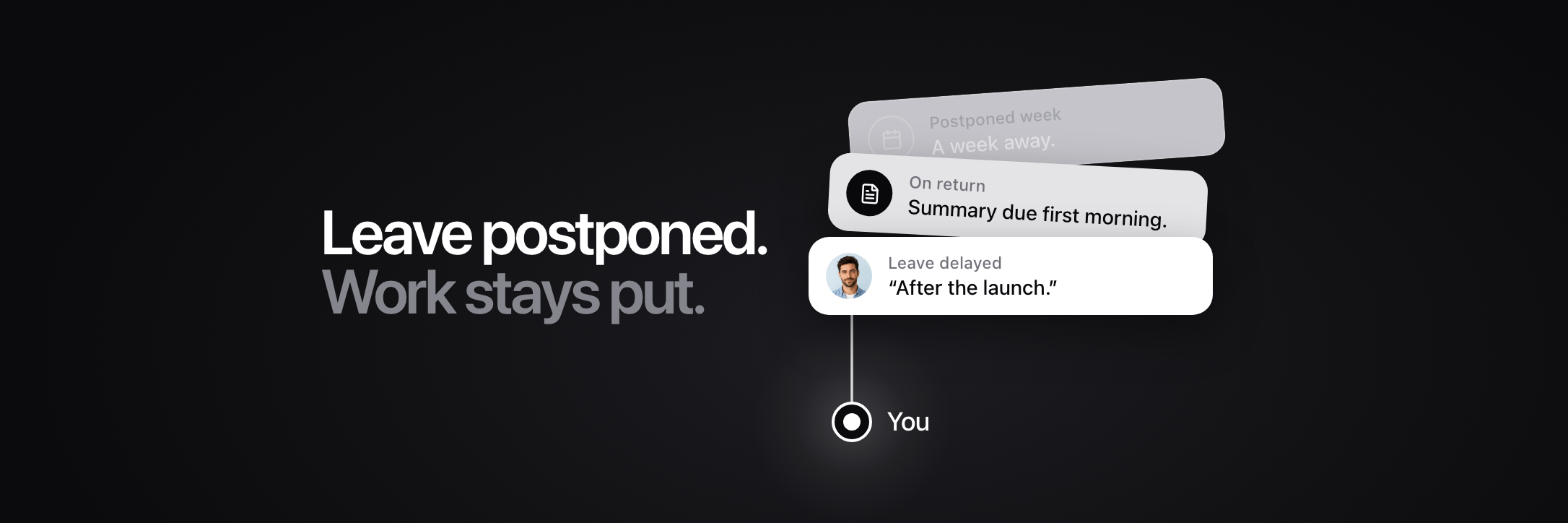
James works in customer operations in a hypothetical 24-person company. Each time his manager asks about a week away, he says, 'After the launch.' The launch has moved twice. James expects to handle customer questions during any absence and return to five days of unfinished follow-up.
The manager asks, 'Which part would still need you if you were away next week?' James names the launch inbox and a customer summary due on his first morning back. He is not asking for someone to watch the inbox while he answers it on his phone. He wants to know who can make a decision when a customer needs one.
The manager checks the plan with Serena, the account lead. Serena agrees to own launch questions during the proposed week, including decisions within her existing authority. The manager moves her routine reporting task to make room and tells the team where questions should go. Decisions outside Serena's authority go to the manager, with the customer's timing made clear.
The owner of the customer summary agrees to a later deadline. James's first morning back is reserved for an update from Serena and a review of outstanding work. The summary is no longer due before he has heard what happened. The manager confirms these changes with James and asks whether that week now works for him; the dates still need to go through the company's leave process.
They agree on the week. James prepares the specific handover during working time. The team is told that Serena owns launch questions, and the manager takes responsibility for making that route work. James is not asked to check in each day. None of this establishes why another employee postpones leave; it shows what a manager can change once the actual obstacle is clear.
Check the absence and the first days back
In the example, the useful questions are whether launch questions reached Serena, whether any routine request still reached James and whether the summary deadline really moved. If a colleague contacted him because nobody knew the route, repair the route. If he felt he had to monitor the inbox despite your agreement, ask what made that seem necessary before treating it as unwillingness to stop working.
Review the first days back as well. A calendar block labelled 'catch up' is ineffective if meetings and deadlines fill it. Decide which new work needs attention, what has already been resolved and what can wait. Do not quietly restore the original deadline because the employee has returned.
For employers and workers in Great Britain, Acas's guidance on asking for and taking holiday is a starting point for checking the rules. Use the relevant local authority elsewhere. Keep holiday approval and balances in the appropriate leave process; a team conversation does not replace it.
If leave repeatedly exposes unclear ownership, Fundamentals can provide context for discussing team expectations. Keep the current work agreement accessible to the people who need it, with private reasons kept out. Cooperly does not approve leave, determine entitlement or certify that cover is ready.