When an employee is not getting a raise this cycle, tell them yourself, in private, before a payslip or a colleague does. Start with the decision, give the reason that actually applies to them, and say what would change the answer and when you will look again. Before the conversation, check whether a contract, an earlier promise or a statutory minimum means the increase is not yours to withhold.
What you'll learn
- Name which of three pay decisions you are actually delivering.
- Check obligations and earlier promises before the conversation, not after it.
- Leave with a written review date and criteria the employee can check.
Not getting a raise: name the decision before the reason
Founders often treat these as the same decision because the payslip looks the same in every case. The employee hears them very differently. A freeze that applies to everyone says nothing about their work. An increase for colleagues but not for them says something specific, and they will want to know what. A salary already at the level the role supports is a question about the role, not about effort.
| Decision | What the employee needs to hear | What to offer next |
|---|---|---|
| No increases for anyone this cycle | That the decision covers everyone, the business reason and that it is not a verdict on their work. | The date pay will be revisited and what that review depends on. |
| Increases for some people, not for them | The specific gap between their current contribution and what the increases rewarded, with examples you have already discussed. | The evidence that would support an increase at the next review, and the support you will give. |
| Pay already matches the role | Why the role is paid where it is and how you checked it. | What a larger role would involve, if one exists. If none does, say so. |
When the honest answer is a mix, such as a company-wide freeze and a performance concern you have never raised, deal with the concern separately. A pay conversation is a poor place to hear about a problem for the first time. When performance is the reason, the feedback should already exist; the guide to telling an employee they are not ready for a promotion uses the same evidence-first approach.
Check what you owe before you decide what to say
In Great Britain, Acas says there is generally no legal requirement to give a pay rise. The exceptions it lists are an employee on the minimum wage when that rate increases or when they move into the next age bracket, and a contract that entitles them to a rise. Where nothing is written down, a rise can still become an entitlement through custom and practice. Even a discretionary rise should be decided fairly, and Acas says that if some employees will not receive it, there should be clear reasons.
UK minimum wage rates change on 1 April every year, so a freeze cannot keep anyone below the new rate. Outside Great Britain the rules differ: check the contract and local employment law, and get qualified advice before relying on a decision that someone could dispute.
Then check what was said informally. A line such as 'we'll look at your pay after the launch' in a one-to-one is a commitment the employee remembers, even if nobody wrote it down. If you cannot keep it, say so directly rather than letting the date pass.
CIPD surveyed more than 2,000 UK employers and also expects real pay growth to fall below zero over the coming year. In the US, WorldatWork's survey of 1,799 organisations projected a mean salary increase budget of 3.6% for 2027. Neither figure tells you what your company can afford, and neither describes small teams specifically. They do show what employees may be comparing their own pay against. When prices rise and pay stays flat, the employee is worse off in real terms, so do not describe the decision as keeping their pay the same.
Say the decision first, then the reason that applies
- 01
Talk before the news arrives elsewhere
Hold a private conversation before pay statements, a team announcement or a colleague's comment reach the person. Leave time for questions; do not fit it into the last five minutes of a project meeting.
- 02
Say the decision in the first minute
'I want to talk about the pay review. There won't be an increase to your salary this time.' Then pause and let them react before you explain.
- 03
Give the reason that is true for them
For a freeze: 'Nobody is getting an increase in January. Revenue fell after two clients paused work, and I'm not willing to commit to costs I can't cover.' For an individual decision, name the specific gap and the examples you have already discussed. Do not compare their pay with a colleague's.
- 04
Acknowledge the cost
'With prices still rising, this means your salary buys less, and I know that matters.' Do not ask them to be grateful or tell them that other people have it worse.
- 05
Name what would change the answer and when
Give the date of the next pay decision, what it depends on and who makes it. If you do not know whether money will be available then, say so. A review date is a promise to decide again, not a promise of an increase.
- 06
Confirm it in writing
Afterwards, send a short private note with the decision, the reason, the review date and anything you agreed to do.
If they ask what it would take, describe observable evidence rather than effort: the responsibilities, results or skills an increase would reflect. If they say they will look elsewhere, do not make a counter-offer on the spot. Treat it as information, and use the guide to responding when an employee asks for a raise to decide whether their market case changes your decision.
Work through one case: a freeze that hides a role change
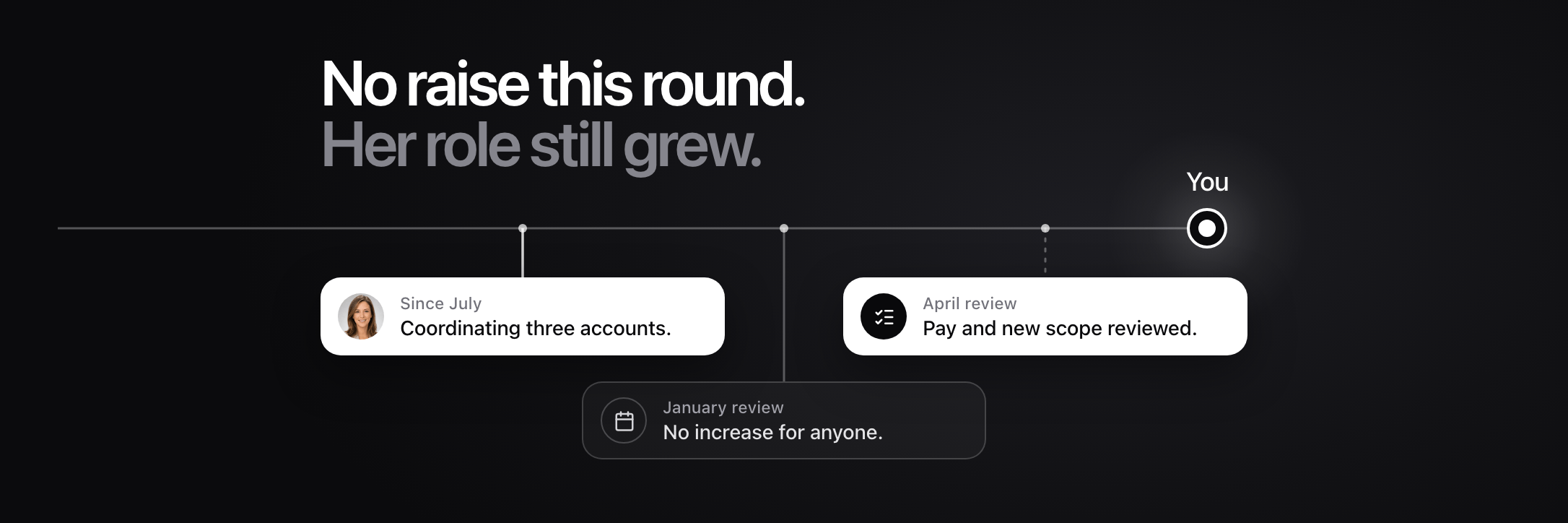
In a fictional 18-person design studio, two clients paused their projects in September. The founder decides that nobody will receive a salary increase in the January review and that pay will be revisited in April, when the studio expects to know whether that work is coming back.
Priya, a senior designer, has coordinated three client accounts since July because the account manager left. Her salary reflects the design role she was hired for. If the founder delivers only the freeze message, Priya hears that her extra responsibility counts for nothing.
So the founder separates the two questions. The freeze is the same for everyone: 'There won't be an increase for anyone in January, including you. Two clients paused work, and I won't commit to salaries I can't fund.' The role question is specific to Priya: 'You've been coordinating accounts since July. That's more than your role was set up to cover. I need to decide whether that responsibility stays with you and, if it does, how it's paid.'
They record the agreement in writing. There is no pay increase in January. By the end of February, the founder decides whether account coordination becomes part of Priya's role or moves to someone else. The April review covers company-wide pay and, if her role has changed, whether her salary reflects the new responsibilities. The founder does not promise a figure, and Priya can check each date.
After the conversation, keep the review date real
Put the review date in your calendar with the criteria you named. Before it arrives, gather what you said you would check, such as the revenue position or the role decision. At the review, give the answer even if it is still no, and explain what changed and what did not. If the date has to move, tell the employee before it passes and give a new one.
When the freeze covers the whole team, tell people individually or in small groups before any wider announcement, and use the guide to communicating bad news to your team for the group conversation. Keep individual reasons out of shared channels.
In the following weeks, notice whether the person engages differently: quieter one-to-ones, fewer suggestions, less willingness to take on extra work. Ask about it directly rather than assuming. Recognition and interesting work can matter, as the guide to motivating employees without money explains, but they do not replace pay. Some people will still decide to leave, and an honest conversation does not prevent that. It gives them accurate information to base that decision on.
A shared Fundamentals discussion can make a team's working expectations and responsibilities visible, which helps when a role has grown beyond what it was set up to cover. Cooperly does not set or recommend pay; the founder still makes the decision and keeps individual pay details private.