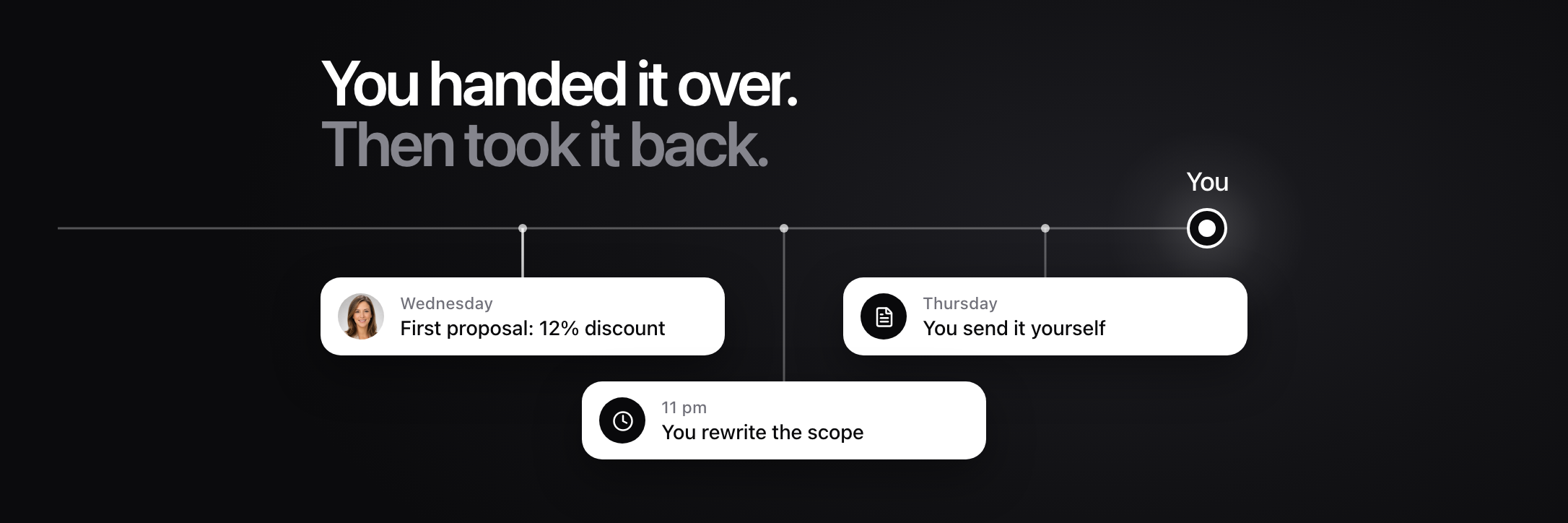
When a founder can't delegate, it is tempting to put it down to personality: control, perfectionism, trust. Before you accept it, open the last handoff that came back to you. Check whether the standard for finished work existed anywhere except your head, and whether the person got the decisions inside the task or only the task. Then check whether you stepped back in before they had finished. To delegate as a founder, fix the point that broke, then run the same handoff at least three more times before you judge the person or yourself.
What you'll learn
- Find which of three points broke your last handoff.
- Hand over the decisions inside a task, with written limits.
- Decide what to do at the moment you want to take the work back.
Before you delegate as a founder again, find where the last handoff broke
Pick one piece of work you handed over in the last two months and later did yourself or redid. Open what you sent when you handed it over and what came back, and read them against the table.
| Break point | What you notice | What it looks like from their side | What to change |
|---|---|---|---|
| The standard stayed in your head | The result is not quite right, and you can't say why until you see it. | They did what the brief asked. The brief left out the checks you make without thinking. | Write down what finished looks like and the two or three judgement calls you make every time. |
| The decisions stayed with you | They ask about every exception, or they decide something you would have decided differently. | Nobody said which calls were theirs, so they either ask or guess. | Say which decisions they make alone, which they make and tell you about, and which they bring to you first. |
| You took it back | You redid it late at night or sent your own version before theirs was finished. | Their work was replaced without a conversation about what was wrong. | Before stepping in, name what was missing and fix that. Give the work back for the next round. |
The third row is easy to miss because from your side it looks like a rescue. If your version has replaced theirs before, they may start sending you early drafts and waiting for your changes; ask them whether that is what is happening. You then see someone who can't work without you, and the handoff looks like proof that you can't let go.
Your involvement may also affect how you judge the work. In a lab study published in 1998, Jeffrey Pfeffer and colleagues found that people acting as managers rated a piece of work more highly the more they had been involved in producing it. The participants were MBA students designing an advertisement, not founders, so treat the finding as a caution: when you compare their draft with the one in your head, check whether your involvement is affecting your judgement.
One cause looks like a delegation problem and isn't. If the work arrives late because it sits behind the person's own job, a better brief won't create hours. Take something off their list or plan a hire; choosing a founder's first hire covers that decision.
A worked example: the proposal rewritten at 11 pm
Here is a hypothetical example. The founder of a 19-person branding agency hands new-client proposals to Priya, the account lead, so proposals stop waiting for the founder's evenings. Priya has written parts of proposals for two years. The first complete proposal Priya writes is ready on a Wednesday and offers a 12% discount to win a larger scope. The founder reads it at 11 pm, cuts the discount, rewrites the scope section and sends it on Thursday morning without talking to Priya.
Two things broke before the rewrite. The agency's discount rule, no more than 5% on a first project and only with a signed retainer, had never been written down; the founder applied it from memory. Nobody had said whether discounts were Priya's decision at all. The overnight rewrite then added a third problem: next time, Priya may send the draft to the founder and wait for another rewrite.
They change three things. The founder writes a one-page proposal standard: the scope sections every proposal needs, the minimum price for each and the discount rule. A discount of up to 5% with a signed retainer is Priya's call; anything above that Priya brings to the founder before sending. For the next three proposals, the founder reads each draft by an agreed time the day before it is due, comments in the document instead of rewriting it, and Priya sends it. After the third, the founder reads proposals after they have gone out.
Delegate as a founder one handoff at a time
- 01
Pick work that comes round again
Choose something that repeats every week or month and that you can describe: a proposal, a client report, a first-round interview. A one-off emergency is a poor first handoff because there is no second round in which to fix the brief.
- 02
Write down what finished looks like
List what the result must contain and the judgement calls you make without noticing: the price floor, the tone with an unhappy client, the point at which you would escalate. If you can't write it yet, do the next one together and write it as you go.
- 03
Hand over the decisions with limits
For each judgement call, say whether they decide alone, decide and tell you, or bring it to you first. Put the limits in writing, next to the standard. The same three lists help with an employee who checks every decision with you.
- 04
Agree when you will look
For the first two or three rounds, review before the work goes out, at an agreed time, and comment instead of rewriting. Then move the review to after it has gone out.
- 05
Agree when you will step in
Name the cases that justify stepping in before the review: a risk to a client relationship, money above the agreed limit, a legal question. Everything else waits for the review.
When the same question keeps coming back from several people, the limits belong in a wider decision map for the founder bottleneck rather than in one person's brief.
Is struggling to delegate a productivity problem?
When Gallup assessed the talents of U.S. founders who employ at least one person, three in four had limited-to-low levels of Delegator talent.
Gallup measured a talent profile from an assessment, not how anyone handed work over, and the data comes from the United States in 2014. It doesn't say that a low score stops anyone from delegating. Read it as a reason to put the handoff on paper instead of waiting to become a natural delegator.
Start with your own week. A founder bottleneck audit sorts the decisions, drafts and rescues that came back to you last week, and the delegation debt calculator puts hours against one recurring task so you can compare candidates for the next handoff.
When the handoff still fails after three rounds
Review after the third round with the person, using the drafts and your comments. A question that keeps coming back may mean the standard is missing a line; check that together and add it if needed. Work that is right but late points to their list: check what else sits on it. When they decide within the limits and the result is still wrong, check for a skill gap: teach it, pair on the next round, or give the work to someone else. Then count how often you stepped in outside the agreed cases. Anything above zero means the takeback rule needs work.
Some work belongs with a founder for now, such as a relationship with a key client or a decision only you can be accountable for. Keep it, and tell the team so they stop waiting for a handoff that isn't coming. If the person holding everything is one of your managers rather than you, read what to do when a manager never delegates.