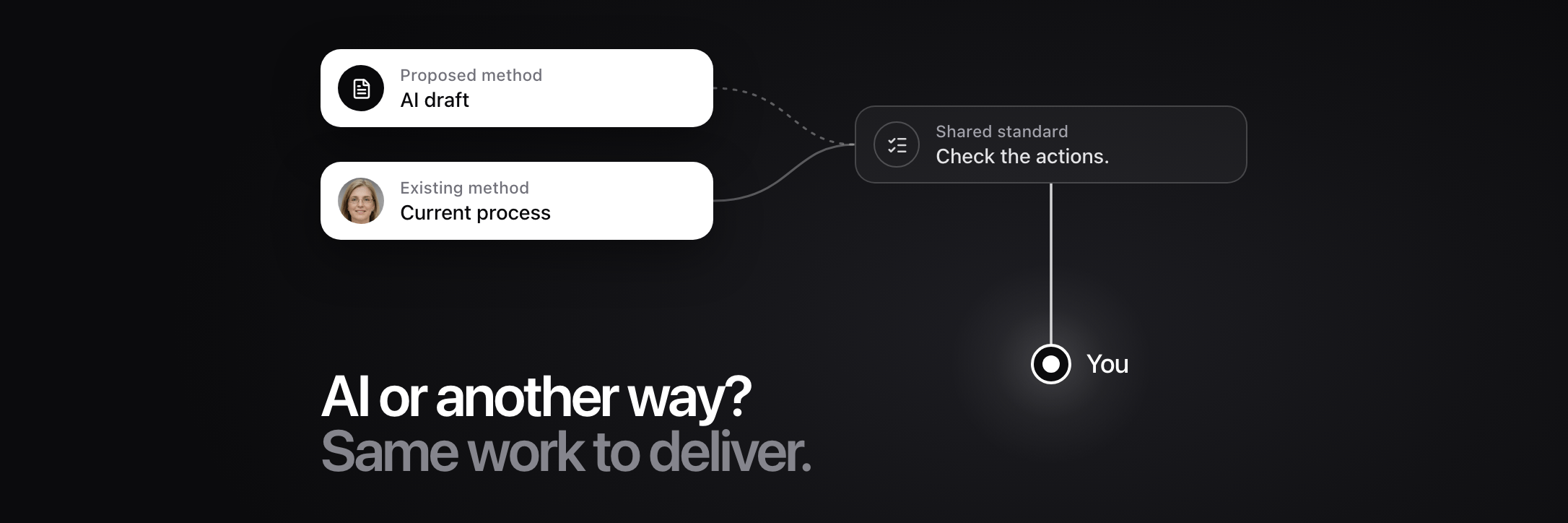
If an employee does not want to use AI, ask about the particular task and listen to the concern before deciding what happens next. Check whether using the tool is an experiment or an established requirement, and whether another permitted method can meet the same work standard. Leave the conversation with an interim arrangement, an owner for any open question and a date to return to it.
What you'll learn
- Separate the work outcome from the proposed method.
- Test the real quality and checking work before assuming AI saves time.
- Make a decision the employee can work with, including when the answer is not yet known.
When an employee does not want to use AI, start with the task
In a private conversation, try: 'I suggested using the tool to draft the weekly customer summary. What concerns you about using it for that work?' Then listen without treating the answer as a problem to overcome. The person may have found errors, be unsure which information is permitted, object to the technology on principle, or worry about what a change means for their role. More than one concern can be present.
Gallup's survey included 23,717 US employees; the figure applies to the smaller group who did not use AI and worked where it was available. It is a reported belief, not a test showing that AI could or could not help. Gallup did not give a separate small-team result in that article. Ask this employee about their actual task rather than assuming that the survey explains their response.
Be precise about the expectation. 'We are trying this tool' is different from 'this step is part of an established process'. If you are unsure which applies, say so and find the person who can clarify it. Do not turn an invitation to experiment into a new requirement in the middle of the conversation.
Check the work standard and the method separately
- 01
Name the result
Describe what the next person needs to receive and when. For a customer summary, that might mean a faithful account of the agreed actions, linked to the source record and ready for the account lead to review.
- 02
Check the proposed route
Identify the approved tool, what information may go into it, who checks the output and how an error is corrected. If permission or data handling is unresolved, keep using an approved process while the right owner answers; do not upload a live example to find out.
- 03
Compare the whole task
If the employee is willing and both routes are permitted, compare a suitable example against the same standard. Include preparation, verification, correction and the next person's review, not only the time it takes to produce a first draft. One example informs the decision; it does not prove how every future task will perform.
When an employee does not want to use AI for ethical reasons, a timed comparison will not necessarily answer the concern. Ask what decision the person needs and who can make it. They can explain their concern without having to persuade you to share it. If the issue is access, resolve the access question. If it is a skill, arrange the specific support needed for an approved task rather than assigning generic training before you understand the gap.
A tool that produces a polished draft can still move checking work to someone else. The guide to AI review burden helps trace that handoff. If information is being put into an unapproved tool, use the separate shadow AI guide to resolve the data and permission question.
Work through one proposed change
In a fictional 24-person agency, Serena prepares a weekly customer summary from approved notes. Her manager proposes an AI draft and asks for the summary by noon rather than 2 p.m. Serena says she would rather use her existing method: in a previous attempt, she spent time finding and correcting missing actions. The manager has not checked whether the earlier deadline is possible with either method.
They agree on the same standard: each customer action must match the source note, include an owner and date, and be understandable to the account lead. The manager confirms that a de-identified example is cleared for the approved tool. Serena is willing to compare that example; she is not asked to submit live customer details.
For this illustration, the existing method takes 40 minutes including checks. The AI route takes 15 minutes to prepare and draft and another 30 minutes to verify and correct. Neither figure predicts another task. On this example, the proposed method has not established a time saving, and the noon deadline still needs a separate capacity decision. The account lead's later review is not included in either figure; the manager would need to check that effort separately before deciding which route costs the team less.
The manager keeps the existing method for the next two summaries, confirms the 2 p.m. handoff with the account lead and reserves time to review the deadline with them. If the earlier handoff is genuinely needed, the manager will decide what else can move or what support is available. The manager does not record Serena as resistant for identifying a checkable problem.
Make the next arrangement explicit
Close the conversation with a short work agreement: 'For the next two summaries, use the current process and send them by 2 p.m. I will check the proposed deadline with the account lead and come back on Friday.' Record the task and decision in the place the relevant people use. Keep personal explanations out of shared notes unless the employee has agreed to an appropriate disclosure.
At the review, bring the answer back even if it is incomplete. If you found that another team depends on an earlier handoff, show that dependency and discuss how to make it workable. If the method itself has become a genuine organisational requirement, explain the decision, the support available and the route for raising a remaining concern. Do not imply the person agreed simply because they listened.
For a concern about whether AI will change the person's role, use the separate AI job anxiety conversation guide. That discussion needs an honest account of what is known and unknown, not a promise that the role can never change.
A shared Fundamentals discussion can help a team make working expectations visible. Cooperly provides context for the conversation; the manager still decides the work arrangement and handles any confidential employment issue through the appropriate channel.