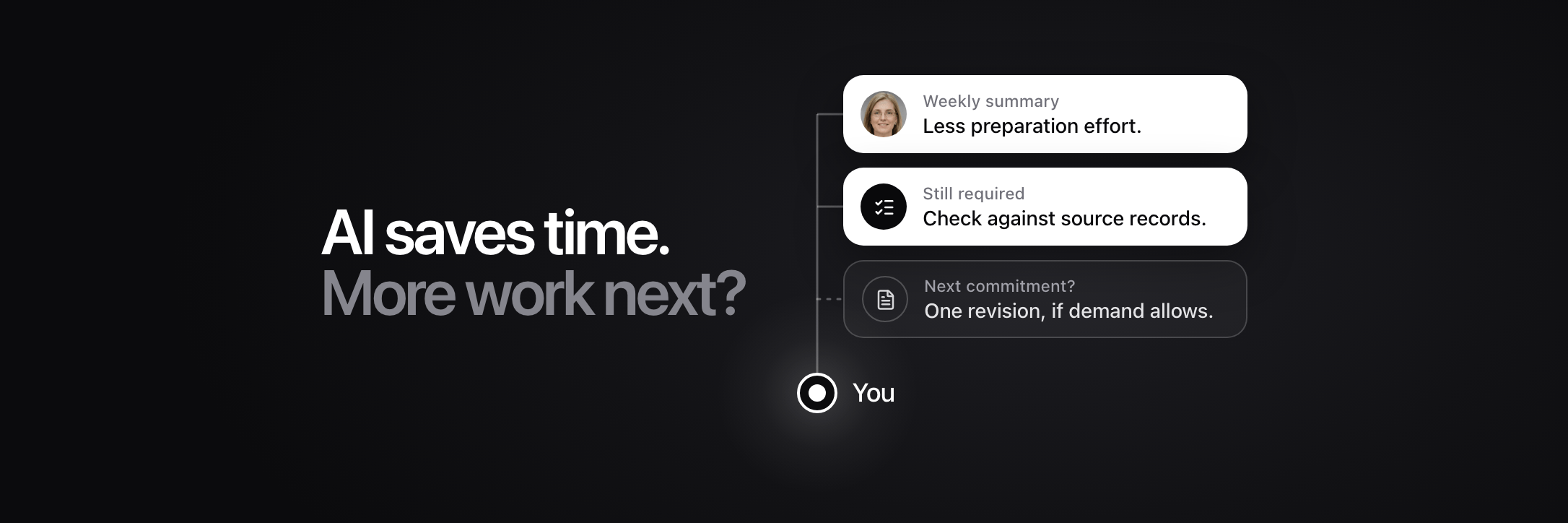
AI time savings can justify a new work commitment, but a faster task does not tell you what that commitment should be. Check what has changed, discuss the employee's remaining workload and choose where the useful capacity should go. Try one bounded change before treating the gain as a permanent increase in output.
What you'll learn
- Distinguish a reported time saving from capacity you can reliably plan around.
- Choose a useful next outcome with the employee, including what takes priority.
- Review one changed commitment before resetting recurring expectations.
AI time savings leave a decision for the manager
An employee tells you an approved AI tool has made their weekly summary much quicker. You have a backlog, so asking them to take something else on may be sensible. First establish whether the saving is repeatable and what kind of work would fit. Finishing an email sooner does not necessarily create an uninterrupted afternoon for a new project.
The finding comes from 7,845 U.S. employees who had used AI in their job at least a few times in the previous year, surveyed from 26 January to 24 March 2026. These are employees' assessments, not measured productivity or verified increases in hours. Additional responsibility is not necessarily a bad outcome, and the survey does not establish a rate for small companies or the UK.
Use the conversation to settle what will change, rather than treating the disclosure itself as acceptance of extra work. Explain which decision you can make and which needs approval. Do not promise that AI use will never affect roles or staffing if you cannot control those decisions.
Check which part of the role became quicker
Ask: 'Which part now takes less effort, and what still needs your attention before the work is usable?' The answer may be drafting, finding information or formatting. Preparation, judgment, checking and dealing with exceptions may remain. Check a few comparable completed items together, using records you already have and the employee's account.
If the apparent gain depends on someone else repairing the result, follow the separate guide to AI workslop and whole-team effort. Here, assume the work can meet its standard. The narrower decision is what to do with capacity that may now be available.
Look at the shape of the saving. Several short gaps between customer calls may help someone finish routine administration within the day. They may not support a task requiring sustained concentration. Ask about busy periods, learning time and irregular work that the quiet example did not include. Do not count a reduction in unpaid overrun as spare capacity to fill while leaving the old workload problem intact.
If the discussion reveals that the role already carries more than it can reasonably handle, make a workload trade-off first. Do not use an estimated AI gain to declare that existing overload has been solved.
Choose the next outcome before adding a target
Gartner's March 2026 guidance asks managers to connect the use of time saved through AI with role outcomes, development needs and employees' capabilities and aspirations. That is a useful set of questions for a small team, rather than evidence that one allocation will work everywhere.
- 01
Name the purpose
Choose the result that matters now: more of the existing work, better quality, an overdue improvement or a specific learning opportunity. Explain why it matters. Leaving some room for variable demand can also be deliberate; filling every gap is not the only useful outcome.
- 02
Check the fit
Ask what the employee thinks is achievable, which skills or access the work needs and how it fits the time actually released. Do not assume the person wants more of the same work, or that a development task takes no management support.
- 03
Set one limit and a fallback
Describe a bounded addition or replacement, who can resolve a conflict and what happens if core work needs the time again. Keep existing availability and required checks explicit. Follow the appropriate approval process if the proposal changes the role or its terms.
Consider colleagues who do similar work. Different task mixes, access to tools and experience can produce different gains. Keep the expected standard clear, and offer relevant support rather than assigning everyone the fastest person's new target. If a colleague shares a useful method, allow time for that sharing; do not quietly add training the team to their workload as well.
Keep tool permission and disclosure expectations in the team's AI working agreement. This allocation conversation starts with approved use. It does not turn a tool experiment into a hidden test of commitment.
Make one changed commitment concrete
Consider a hypothetical customer-operations team. An employee uses approved AI to prepare the weekly customer-issue summary, checking it against the source records before sending it. Recent summaries have been usable with less preparation effort. The manager wants that improvement to benefit customers, and the employee wants more experience improving help content.
They choose one recurring customer explanation to improve during the next summary cycle. The employee will propose a revision and check it against the current product behavior. The product lead still owns approval. The manager supplies the relevant question and arranges the lead's review; the employee does not acquire an open-ended responsibility for the whole help centre.
Their note could read: 'Keep the customer queue and weekly summary at the existing standard. In the next cycle, use the available preparation time to propose one revision to the cancellation explanation. I will get the product lead's input before you start. If queue demand uses that time, tell me and we will pause the revision or change another priority. We will review the result at our next weekly check-in before repeating it.' These are illustrative words, not a prescribed quota or trial length.
During a busy week, the queue takes the available time. The employee flags the conflict and the manager pauses the revision. That is the fallback working as agreed. If the manager instead requires both outputs without changing anything, they have made a new allocation decision and need to explain how it can be met.
If the proposed revision arrives but approval waits on the product lead, keep those two stages separate. The employee can have met their commitment even though the customer-facing change is not live. If the manager never supplies the promised input, address that dependency before judging the employee's follow-through.
Current working preferences in Coop Profile can help you ask how the person wants to discuss a new responsibility or raise a concern. Confirm those preferences with them. A profile does not measure saved hours, decide capacity or set a performance target.
Review the commitment before making it the baseline
In the example, ask whether the summary and customer queue met the existing standard, whether the employee completed their proposed revision and whether the lead provided the review. Check how often the fallback was needed and whether work spilled beyond agreed availability. Completion alone is not enough if the addition was carried through hidden extra effort.
If the work fits repeatedly, discuss whether it should become a recurring responsibility, with a clear scope and the appropriate approval. If the gain is inconsistent, retain a flexible improvement slot or narrow the addition. If checking, queue demand or manager dependencies consume it, stop treating that time as available until something changes.
Let the employee correct the agreement as the work or tool changes. Raising a constraint after a trial starts is information to investigate; it does not by itself prove that the earlier saving was false. Equally, an agreed, feasible commitment still needs follow-through. Discuss the actual miss and the support provided rather than arguing about how productive someone ought to be with AI.
AI time savings become useful when they lead to a realistic choice about the work. Leave the conversation with one explicit commitment, its conditions and the next decision. That gives both people something concrete to revisit when the next busy week arrives.