To tell an employee they didn't get the promotion, do it yourself, in private and before the announcement, so they don't learn it from a channel post or from the person who got the role. Give the decision in your first sentence. Name the requirement that decided it, say honestly whether a similar opening is likely, and book a second conversation a week or two later, once they have had time to think about what they want next.
What you'll learn
- Tell them before the announcement, in words that don't blur the decision.
- Explain the choice through the role, not through the other candidate.
- Plan the follow-up, including when the new person becomes their manager.
Before you tell an employee they didn't get the promotion
- 01
Who tells them
The person who made the decision, or their direct manager if that is someone else. If you made the call as founder, be in the room or on the call. A message or an email is not enough for someone who applied.
- 02
When
After the chosen candidate has accepted, so you don't have to reopen anything, and before the announcement. Leave the person time between your conversation and the announcement to decide how they want to react in front of the team.
- 03
What you can share
The requirement the role needed most and how the decision weighed it. Not the other candidate's pay, private feedback or interview scores.
- 04
What you can offer
Only what is already agreed: a development step, a project, a date to revisit the question. If nothing is agreed yet, say you will bring something concrete to the follow-up, and do.
What to say in the first two minutes
| Moment | What blurs it | What says it |
|---|---|---|
| The opening | "I wanted to talk through how the process went. We had a lot of strong people..." | "I've offered the team lead role to someone else. I wanted you to hear it from me before it's announced on Thursday." |
| The reason | "Honestly, it could have gone either way." | "The role exists to run renewals with our largest accounts, and that experience decided it." |
| What comes next | "There'll be other opportunities soon." | "I don't know of another opening this year. I'd like to talk about what you want next in two weeks, once you've had time." |
Then stop talking. They may ask questions, go quiet or be angry. Answer what you can, don't argue with the disappointment, and don't reopen the decision in the room. If they ask how they compared with the other candidate, talk about the requirement, not the person: what the role needed and what you saw in their own work against it.
A hard choice needs its reasoning settled before this conversation; choosing between two internal promotion candidates covers that. When someone asked for a promotion and there was no selection at all, it is a different talk: telling an employee they are not ready for a promotion.
A worked example: an internal candidate and an external hire
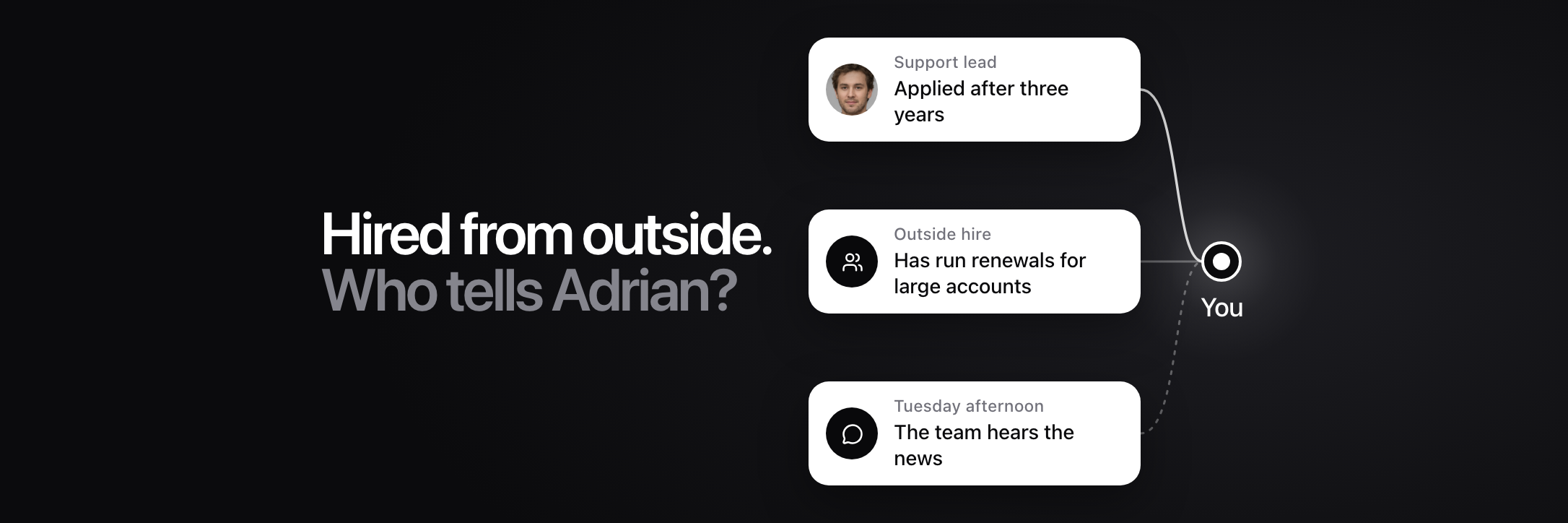
Here is a hypothetical example. A 28-person software company creates its first Head of Customer Success role. Adrian, who has led the four-person support team for three years, applies. Renewals are why the role exists, so the founder hires an outside candidate who has run renewals for accounts the size of the company's three largest customers. Because the new head will manage the support team, Adrian will report to them.
The offer is accepted on a Monday. On Tuesday morning the founder meets Adrian alone: "I've offered the Head of Customer Success role to someone from outside. I wanted you to hear it from me before I tell the team this afternoon." The founder names renewals as the deciding requirement and says what Adrian's support work showed: the team's response times and the help-centre rebuild. The founder also says plainly that the new head will be Adrian's manager and that no second opening is planned this year. Adrian asks why renewals outweighed three years of support. The founder answers once, then books a follow-up for two weeks later.
Adrian's case, an internal candidate losing to an outside hire, is one that research on internal job markets has looked at directly. Cornell researcher JR Keller followed unsuccessful internal applicants at one large U.S. health services firm.
The two rates cover different time windows, so the figure isn't a multiple, and it comes from one large firm, not a company of 30. Kathryn Dlugos and Keller later published a peer-reviewed study of 9,355 rejections at a single firm. Rejected employees were less likely to leave when the hiring manager had interviewed them, and when the job went to another internal candidate instead of an outside one. Neither study looked at how the news was delivered, so neither can tell you which words keep people. The brief does show some people leaving within months of a rejection.
When the person who got the role becomes their manager
Reporting to the person who got the job is a second piece of news, so don't leave it for them to work out from the org chart. Tell them in the same conversation, and tell the new manager how the decision was communicated so they don't contradict it. Ask the new manager to meet them in the first week and start with the work: what stays with them, what changes and which decisions are now theirs. If the new manager was their peer until now, the first conversation with former peers covers how to open it.
The follow-up conversation
Ask what they want now that they didn't get the promotion; it may have changed since they applied. If they want the same kind of role later, agree what would show progress on the deciding requirement and when you will look at it together. If they are ready and there is simply no role, say so and read what to do when an employee is ready for promotion but there is no role. Don't promise the next opening; you may not control who applies or what it will need.
Watch the weeks after it, too. If they stop volunteering for work they used to pick up, ask about it directly instead of guessing what they plan. Some people decide to leave after a rejection, and you can't always prevent that. You can make sure the decision, the reason and the next step were clear and came from you.