Managing former peers starts with acknowledging that the relationship has changed. You may still be friends, but you now have responsibilities that affect their workload, feedback and opportunities. Use the first private conversation to explain the decisions you own, hear what concerns them and agree how everyday work requests will reach you.
What you'll learn
- Prepare a first 1:1 that gives your former colleague room to respond.
- Keep work decisions accessible to the whole team, including your friends.
- Review one real request to see whether you followed the agreement.
A 2018 qualitative study explored this tension through 33 interviews across two mining companies and a childcare organisation. Participants described difficulty using authority over friends or feeling vulnerable to being taken advantage of. Its focus was same-sex friendships in those settings; it did not measure how common the problem is or test a conversation script. The conversations below are suggested wording, including one hypothetical example.
Managing former peers starts with a clear remit
CCL researchers coded open responses from leadership-programme participants, mainly from the United States. This broader category included former-peer relationships, but the figure is not a rate of difficulty managing friends. The sample was not representative of all new managers, and these are older data, not a measure of today's teams. Use the finding as context for the role change; ask your colleague how it feels for them.
Ask your founder or manager what comes with the role: who sets priorities, who gives performance feedback and which decisions still need their approval. If you are a team lead who coordinates delivery but cannot decide pay or promotions, say that plainly. A title does not give you powers the company has kept elsewhere.
Have the person who appointed you announce the reporting change to the team and explain your remit. You should not have to prove your authority through a series of uncomfortable private exchanges. If you will keep doing specialist work as well, agree what will move off your plate so you have time to manage.
If your own role is still being negotiated, settle that first. The individual contributor versus manager guide can help separate specialist delivery from responsibility for other people's work.
Name the change in your first 1:1
- 01
Say what you are now responsible for
Use the actual remit. For example: “I'll now be setting the team's weekly priorities and giving you feedback on your work. Pay decisions still sit with the founder.” Adapt the words to your role; do not announce authority you do not have.
- 02
Make room for their response
Ask: “What feels different about working together now? Is there anything you want us to handle carefully?” Listen to the answer. They do not have to reassure you, endorse your promotion or promise that the friendship will stay the same.
- 03
Agree how the next work request will happen
Choose an ordinary situation you expect soon, such as a change in priorities. Explain where the request should go, what information you need and when you will respond. Ask whether that route is workable for them.
With a close friend, you can acknowledge the personal part directly: “I value our friendship. I also know it may feel different when I'm making decisions about your work. I don't want us to guess what the other person expects.” Keep it brief enough that they have space to talk.
If they also applied for the role, allow disappointment. You can discuss how you will work together while leaving the selection decision with the person who made it. Do not disclose another candidate's assessment or make a future promotion promise to soften this conversation.
Put the next request through the agreed route
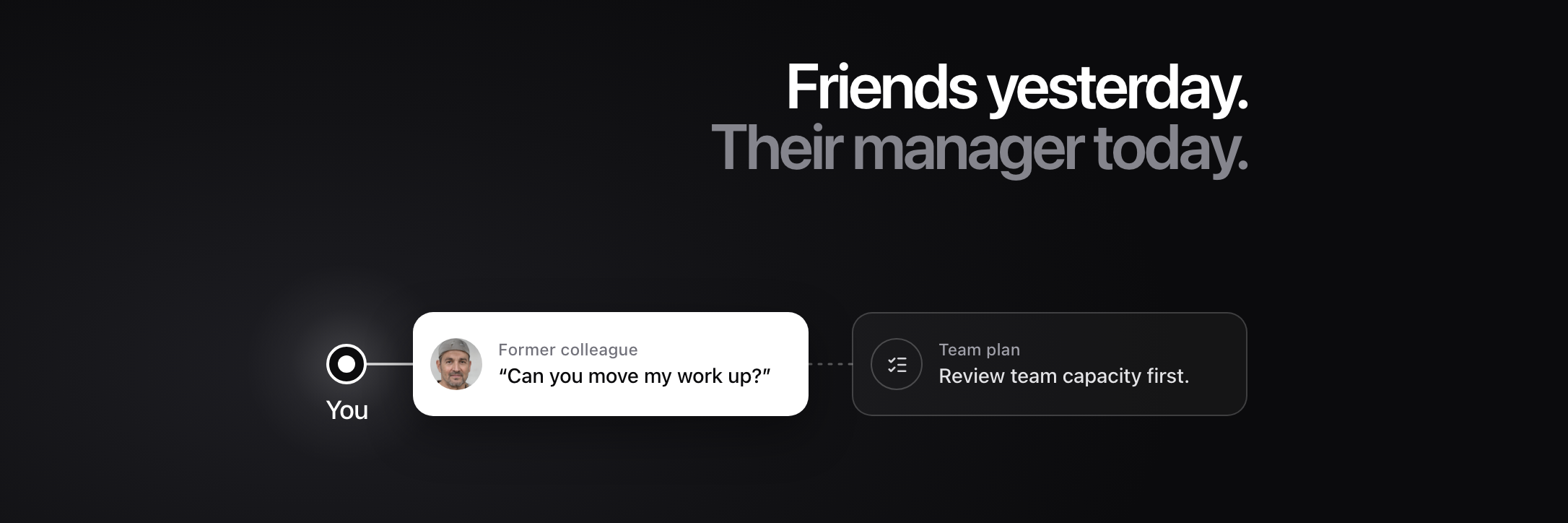
Consider a hypothetical former colleague who catches you at lunch and asks: “Can you move my work up?” Their client is chasing a response. Before the promotion, you might have helped by doing a quick favour. Now you would be moving other people's commitments too.
You could reply: “Let's check the team plan. Tell me what the client needs and by when, and we'll see what would have to move.” Review team capacity first. If the request deserves priority, make the change and tell the people affected. Explain the work reason; the friendship is not a reason to approve or reject it.
You do not need to turn every passing conversation into a form. Record decisions that affect other people's work in the place those people use. A teammate who was not at lunch should be able to understand the current priority and raise a competing need.
Fair treatment can include different support for different circumstances. Do not demand more proof from your friend merely to look impartial. Use relevant work criteria, explain what you can appropriately share and keep personal reasons private.
When competing instructions come from above you, use one agreed brief for conflicting instructions. Asking your friend to choose between two incompatible demands leaves the management problem with them.
Give feedback on the work you can explain
If an agreed handover is late, discuss the expectation, what happened and the effect on the work. Ask for their account before deciding why it happened. Do not let several missed commitments pass because the first conversation feels awkward, then surprise them with a long list at review time.
A possible opening is: “The handover was due Tuesday and support received it Wednesday. What happened from your side?” If they say your new priority caused the delay, check that account and your own contribution. A disagreement about the facts needs investigation; it is not automatically a challenge to your position.
Use behaviour-based feedback for the substance of that conversation. Avoid “you should know better because we're friends” or appeals to personal loyalty. Their obligation is to the work they have agreed to do.
If someone raises a concern about your conduct, identify another appropriate person who can hear it. Where that route is unclear in a small company, ask the founder to establish it. The new reporting relationship should not make you the only way to question your own behaviour.
Ask the founder to support the reporting change
If the founder keeps making private priority deals, your first 1:1 cannot settle the reporting relationship. Agree how an ordinary appeal will return to you, and how a genuine decision above your authority will be explained to everyone affected. The founder can change a decision; they should make the changed instruction clear.
Keep a separate route for concerns about you, safety or other serious matters. The guide to an employee going over a manager's head explains why the route depends on what the person is raising. Do not treat every conversation with the founder as disloyalty.
You also need somewhere suitable to discuss your own uncertainty. Use your manager, a mentor or an appropriate peer outside the reporting line. Asking a direct report who is your friend to reassure you about another teammate's performance puts them in the middle of a decision they should not have to carry.
Review one real decision at the next 1:1
For the hypothetical priority request, ask whether the team plan changed, who heard about it and what happened to the work that moved. If you gave your friend a private exception, correct the affected plan and tell the people who need to know. If you were unnecessarily harsh, acknowledge that and reconsider the request on its merits.
You might ask: “When you needed that priority change, was it clear how to raise it? Did I explain the decision? What did I do that made it harder to work with me?” Listen for a concrete problem you can act on. A quiet week or a friendly lunch does not establish that the transition is working.
Cooperly's Fundamentals can help a team discuss working expectations and keep an agreement visible. Managing former peers still requires you to have the conversation and stand behind the next decision. Start with one forthcoming request: agree how it will be handled, then return to what actually happened.