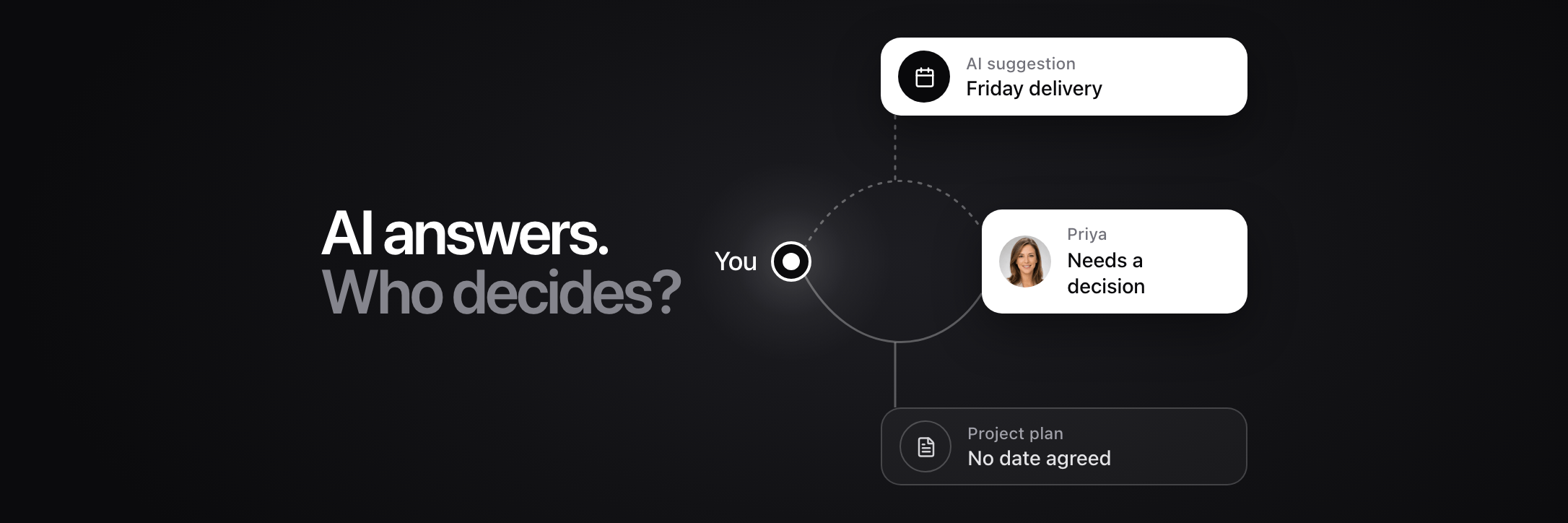
An employee asks AI how to handle a customer request before coming to you. The answer sounds plausible. It also assumes a delivery date your team has not agreed to. The question is not whether the employee should have asked AI. It is what they need to check, and who needs to make the decision, before the answer becomes a commitment.
What you'll learn
- Separate independent exploration from decisions that need an owner.
- Agree where to check team-specific answers and whom to ask.
- Review the handoff without demanding private prompts.
Agree on three routes: which questions someone can explore independently, which answers need checking against a named source, and which decisions or risks must reach a person. Make it easy to ask without exposing a private prompt. Then check whether the agreement helps people find an answer and flag uncertainty in time.
When an employee asks AI, do not assume distrust
This survey describes self-reported habits, not how accurate the answers were or how people in your team behave. Do not require employees to hand over private conversations with a tool as proof.
Separate an explanation from an agreement
A person can use an approved tool to explore a general concept, practise wording or list questions for a meeting, provided the information they enter is permitted. They still need to judge the output. A request for your company's current refund policy, on the other hand, needs the current policy or its owner. A proposed exception needs the person authorised to grant it, even if a source confirms the usual rule.
Try a simple test together: is the action low-stakes and reversible, and can the person take it without changing someone else's work, making a commitment or exposing sensitive information? If yes, independent exploration and a check appropriate to the task may be enough. If the answer asserts a company-specific fact, find the current source. If acting would change a deadline, spending, a customer promise or another person's responsibilities, identify who can decide.
An AI answer can point towards a source; it cannot make that source current or give itself authority. If the source conflicts with what a person remembers, ask the owner to resolve it. The guide to checking shared AI context shows how to test an answer against the source without treating a citation as proof.
Work through a customer deadline
Priya checks the project plan and sees no agreed date for the requested change. She sends the founder a short note: 'The client asked for Friday. The plan does not cover the extra work. Can we agree what moves before I reply?' The founder checks capacity with the designer and decides whether to offer a different date. Priya sends the answer they agreed and updates the project plan. She does not need to share her prompt; the team needs the request, uncertainty, decision and owner.
If the founder is unavailable, the agreement should say who can decide or what Priya can tell the client while waiting. If the request reveals a security incident, it goes straight to the incident contact. The early escalation guide helps teams agree when to raise a risk.
Make the route to a person easier than guessing
Write down the agreement where the work happens. For example: 'Use the project plan for agreed dates. Before offering a different date, ask the delivery owner. If the owner is away and the client needs an answer today, contact the founder. Until a decision is made, acknowledge the request without promising a date.' Check that the named people accept the responsibility and that the plan is accessible to the people who need it.
Keep tool and data rules alongside this agreement, but do not assume that an approved tool is suitable for every piece of information. The shadow AI guide covers how to agree permitted uses and data boundaries. For a sensitive employment concern, offer a private human route and explain its confidentiality limits; a team agreement is not a substitute for specialist advice or an established reporting process.
Review the handoff, not private prompts
Do not count fewer questions as success. It may mean the source is clearer; it may also mean people have stopped asking. Invite people to raise concerns privately. When someone reports an answer that needs correcting, thank them for raising it and agree the next step. If an error has already reached a customer, address the impact and correction first, then examine the route without presuming the tool caused it. Follow any incident-reporting requirements that apply.
Cooperly's Fundamentals can help a team discuss working expectations and make an agreement visible. Selected, permissioned Cooperly context can also be made available read-only to approved AI tools; it does not make the answer automatically correct or decide on the team's behalf. The person with the relevant authority still makes the decision.