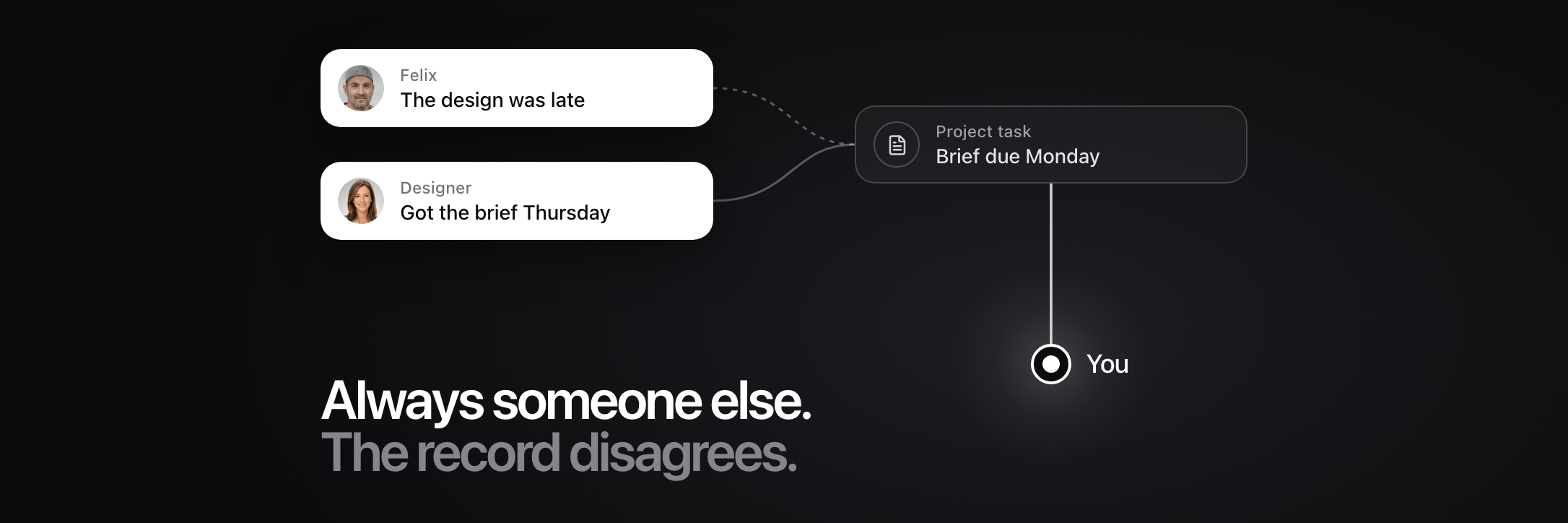
When an employee who blames everyone else misses another deadline, don't start by arguing about their attitude. Take the last two or three misses and rebuild each one from the record: what was promised and by when, who held the work at each handoff, where it first slipped and when your employee said anything about it. Check each miss against three possibilities: their own step was late, someone else was late but they sat on it for days before saying anything, or nobody owned the step where the work stopped. Go through the trails with them, agree who owns the delivery date from start to finish and ask them to flag a slipping step on the day they see it. If they keep naming others where the record shows their own step, treat it as a performance problem.
What you'll learn
- Rebuild the last few misses from tasks and messages, not from memory.
- Tell a wrong account, a late warning and a missing owner apart.
- Agree who owns the date and when a slipping step gets flagged.
Before you talk to an employee who blames everyone else, rebuild the trail
This is for a pattern: several misses in a row, each explained by someone else's delay. One explanation after one miss may simply be true. Pick the last two or three misses and open the task, the messages and the client thread for each. Work from dates and written messages, not from what anyone remembers. For each miss, note four things.
- 01
What was promised, and by when?
Write down the deliverable, the date and who agreed it. If the date was never written down anywhere, note that too.
- 02
Who held the work at each step?
List each handoff with the date the work moved: brief to designer, draft to client, approval to whoever publishes. A step with no name next to it is a finding in itself.
- 03
Where did it first slip?
Find the first step that finished too late for the date to hold. Check whether it came earlier than the step everyone argues about.
- 04
When did they raise it?
Find the first message in which your employee said the date was at risk, and who saw it. A warning sent on the morning of the deadline may leave too little time to act.
Each possibility calls for a different fix. If the delay started with their own step, their account was wrong, and that is the part to correct. Where someone else was late but your employee knew for days and said nothing, the cause was real and the late warning is theirs to fix. Judge the warning by when they knew, not by the deadline: a slip they spot and flag on the due date itself is the rule working. A step nobody owned is different: each person could reasonably think it belonged to someone else, and closing that gap is your job.
The figure covers U.S. employees in companies of every size, and it measures how clear people say their expectations are, not how often they blame colleagues. Treat it as a reason to check “that wasn't my job” before you dismiss it: was the owner of that step written down where both people could see it?
A worked example: three late deliveries
Here is a hypothetical example. Felix is an account manager at a 24-person marketing agency. Over six weeks, three client deliveries go out late, and each time he names someone else: the designer was late, the client sat on the feedback, the developer never published. The founder rebuilds the three trails from the project tool and the client emails.
| Delivery | What Felix said | What the record shows | Group |
|---|---|---|---|
| Launch email, due on a Tuesday | The design was late. | Writing the design brief was Felix's step, due the Monday before. He sent it on Thursday evening, and the designer delivered on the Tuesday the email was due. | The record contradicts him. |
| Landing page, due on the 14th | The client sat on the feedback. | The client sent feedback four days after the agreed date. Felix saw the delay on the 8th and told the client and the founder on the 14th. | The delay started elsewhere; the warning came late. |
| Monthly report, due on the 1st | The developer never published it. | The report was finished on time, but the publishing step had no owner in the project tool: the developer waited for Felix to ask, and Felix expected the developer to see it was ready. | Nobody owned the step. |
Read down the last column. Felix's explanation was wrong once, partly right once and right once. If the founder had opened with “you always blame other people”, Felix could have pointed to the report and the landing page, and the meeting could have turned into an argument about those two. With the trails on the table she can be specific: the brief went out three days late, the landing page warning came six days after he knew, and the report fell into a gap she will fix.
They agree three changes. Felix owns each client delivery date from start to finish, which includes chasing the steps other people do. When a step he depends on slips, he tells the client and the founder that day. The founder adds a named owner to every step in the project template, starting with publishing. They will look at the next three deliveries together.
Talk about the next handoff, not the verdict
Show the trails before you say what you think they mean. If you open with a general accusation, an employee who blames everyone else can answer it with the cases where they were right. Ask them to walk you through each one, and listen for anything the record missed, such as a call nobody wrote down or a priority you changed. Where the record contradicts them, say so plainly and once, using the date. Leave their character out of it.
| Opening | What you say | Where the conversation can go |
|---|---|---|
| A verdict | “You always blame other people when things go wrong.” | They can defend each case one by one, and the meeting can turn into a debate about who was late. |
| The record | “The brief went out on Thursday, three days after it was due. What would have got it out on Monday?” | The conversation can stay on one step and what would change it next time. |
Then agree the two rules from the example. The delivery owner chases the steps they depend on, so a designer running late becomes something they raise early, not an explanation afterwards. And a slip gets flagged on the day they see it, to whoever is waiting for the work. A warning before the deadline can give you time to move the date, add help or tell the client. After the deadline, those options may still help, but the agreed date has already been missed. If the whole team warns late, not only this person, read about why teams bring problems to you too late.
Check your own habits as well. In experiments published in 2010, Nathanael Fast and Larissa Tiedens found that people who saw someone blame others for a failure became more likely to blame others for their own, unrelated failures. The participants took part in lab studies, not in a company, so the research can't show that your team copies you. If you discuss a miss in the team channel with someone else's name attached, check your own account against the record too. Discuss one person's misses with them in private, and say so when a miss started with you.
When blaming others becomes a performance problem
At the review, rebuild the trails for the new deliveries the same way. If the warnings now come early and the explanations match the record, keep the arrangement. A miss with a cause you hadn't covered, such as two managers giving conflicting instructions, needs that cause fixed first. If the person keeps naming others where the record shows their own step, or still waits until after the date has passed to flag slips they knew about earlier, tell them the issue is now their performance. Name the deliveries they own, the flag rule you agreed and the trails that show the gap. Set a period, such as a month, with a date to review it together, and send that summary in writing after the meeting. Before you start a formal procedure, check the steps with an employment specialist.
Sometimes the trails point somewhere else. For someone who pushes back on any feedback, not only on misses, read about an employee who gets defensive about feedback. When the steps nobody owned outnumber everything else, the performance problem may really be unclear responsibility. And if the misses come with no explanation at all, start with an employee who keeps missing deadlines.