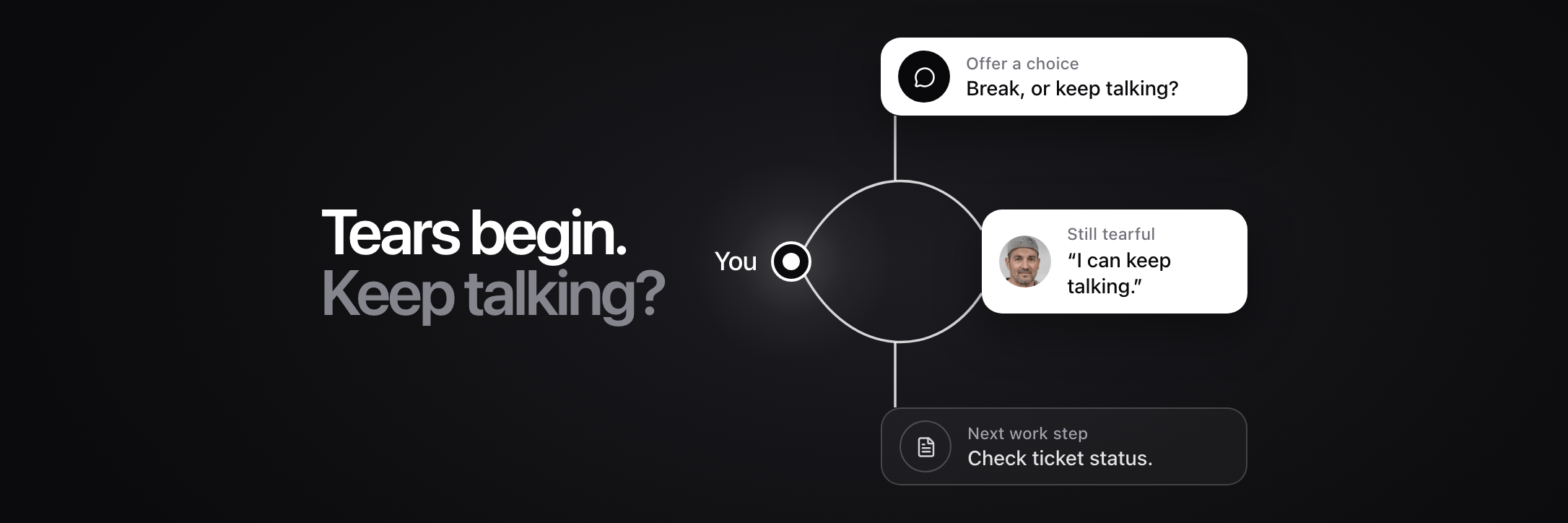
When an employee cries during feedback, stop talking long enough to ask what they need. They may want a break, or be able to continue while still tearful. Choose based on their ability to participate, and return to the work without treating silence or an apology as agreement.
What you'll learn
- Decide whether to continue or pause without interpreting tears as avoidance.
- Hear the employee's account and correct any criticism the evidence does not support.
- Leave with a clear work decision and a useful follow-up, even if the conversation remains emotional.
When an employee cries, ask whether to continue
Leave a little silence. Offer a tissue or water without making a production of it, and ask a simple question: 'Would you like a break, or would you prefer to keep talking?' Avoid 'Don't cry' or 'There's nothing to be upset about.' You do not need to decide why they are crying before responding respectfully.
Listen to the answer and how the conversation is going. Someone who remains tearful may be able to ask questions, explain their work and discuss a next step. If they want to continue, take one point at a time and keep checking that they can and want to continue. Do not make dry eyes the condition for being heard.
A 2017 paper by Daphna Motro and Aleksander Ellis examined reactions to negative feedback through scripted videos watched by 169 U.S. adults. The researchers found that the crying male employee was perceived as more atypical, with negative effects on observers' evaluations. These were judgments of an actor, not measurements of an employee's actual ability. The study does not establish how often this happens in small teams or whether a particular conversation technique works.
That is a reason to check what you are concluding before writing 'cannot handle feedback' in a review. If the conversation also involves repeated denial of verified facts or shifting blame, address that response through the separate guide to defensiveness about feedback. Tears alone do not put the conversation in that category.
If you pause, keep a realistic return point
- 01
Stop adding feedback
If someone cannot follow the discussion, do not keep delivering examples while they are overwhelmed. Say that you are stopping the conversation for now. Check what practical support they want rather than insisting they explain personal circumstances.
- 02
Name what remains open
Identify the one work issue you still need to discuss. If it is accurate, say: 'We have not yet worked through the customer update or agreed what changes next time.' Do not describe an interrupted discussion as a completed performance agreement.
- 03
Arrange the return
Agree a realistic time and format to resume. A later meeting and a short written example may help; check what is workable. If a time cannot be agreed immediately, specify how and when you will arrange it, with any necessary support.
- 04
Handle urgent work separately
If a customer or colleague needs an answer before the conversation resumes, decide who will cover it and tell the relevant people only what they need to know. Urgency is not a reason to obtain agreement from someone who cannot participate.
Acas's guidance on challenging conversations advises planning for privacy, allowing time for breaks and making the next action clear. It does not prescribe a pause length for every employee. If you say 'tomorrow at ten', that needs to be a workable arrangement, not a rule copied from a script.
Before resuming, check your own example. Use specific behaviour and its effect rather than a verdict about the person. If you discover that the criticism was wrong, correct it; postponing the conversation does not make it more accurate.
Return to the work without demanding agreement
Consider a hypothetical customer-operations team. A manager is discussing an update that described a customer's issue as resolved while engineering was still investigating it. The manager says, 'You sent that without checking with engineering.' The employee starts crying.
The manager stops and offers a break. The employee replies, 'I know the update was wrong. I can keep talking.' They are still tearful, but they ask to open the ticket and explain what happened. Continuing is a choice they can revisit, not a promise to finish the whole discussion.
The ticket shows that the employee asked engineering for confirmation and had not received a reply. They then used the resolved status from an older draft. The customer update was inaccurate, but the manager's claim that they had not checked was unsupported. Those are two different findings.
The manager corrects the accusation: 'You did ask. I was wrong to say you had not checked. We still need to work out what to send when the status is unconfirmed.' This acknowledges the manager's mistake without pretending the customer message was correct. The employee's tears prove neither finding; the work record and their account establish what can be said.
They agree that the next customer update will use the current ticket status and say 'still being investigated' where resolution is not confirmed. The manager will arrange a clear status response from the engineering owner before that update. They also agree who will correct the earlier customer message. The employee is not left to obtain the missing confirmation alone.
Before closing, the manager asks what the employee understands the next step to be and whether anything remains disputed. 'I understand your concern' is an acknowledgment. 'I agree I did not check' would be a different statement, and the evidence does not support it here. Record the actual agreement about the next update without turning an apology into a confession.
If the discussion reveals that nobody had explained which status to use or who must supply it, first separate unclear responsibility from a performance problem. Returning to the work includes correcting the expectation where it was missing.
Keep the record useful and check the next attempt
Keep the note proportionate and store it through the appropriate work process. In the example, the useful record concerns the inaccurate status, the unanswered confirmation request, the corrected accusation and the agreed update. A label such as 'too emotional for responsibility' adds a judgment the evidence has not established.
Do not circulate a personal explanation or add it to a shared team profile because it arose in the meeting. If support or another process requires information to be shared, explain the purpose and who needs it. Avoid promising absolute confidentiality. A private feedback conversation is not permission to collect a medical history.
At the next update, check whether the status was accurate, the earlier message was corrected and the manager arranged the promised engineering input. If an input is still missing, resolve that dependency. If the work remains inaccurate despite a clear expectation and suitable support, address the verified work through the appropriate performance process.
Once the immediate moment has passed, ask what would help with future feedback: an example beforehand, a private live discussion or time to consider a written recap. Current preferences in Coop Profile can be a starting point if the person confirms them. A profile cannot explain tears, predict a reaction or assess someone's resilience or performance.