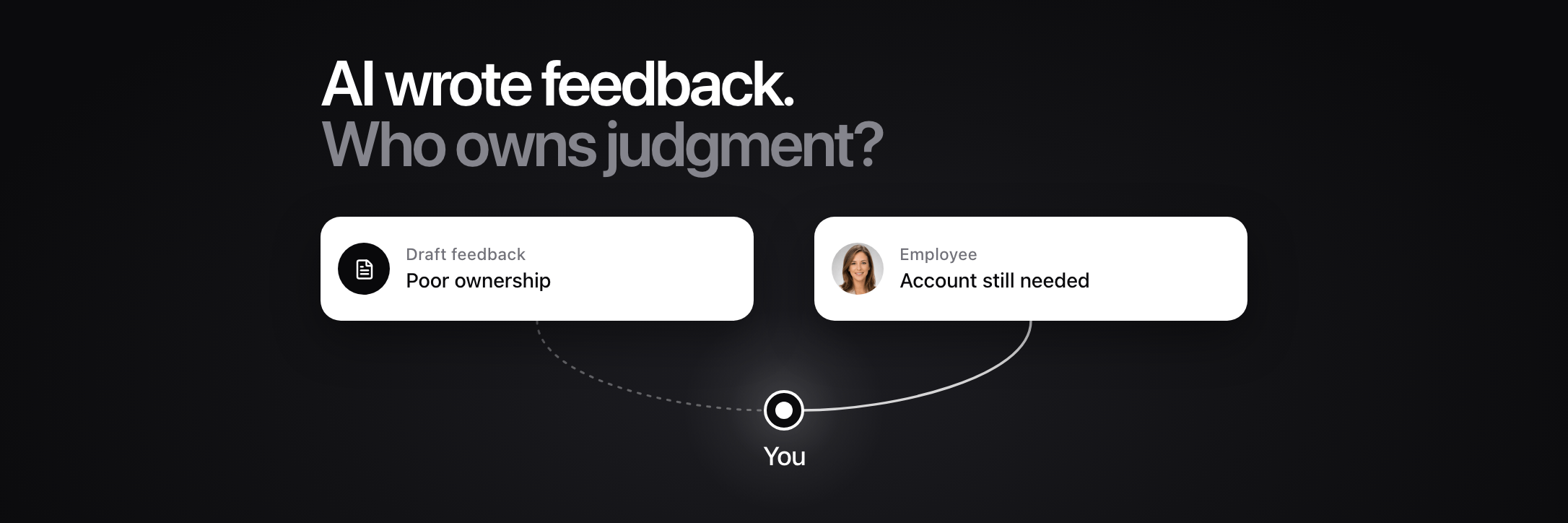
Using AI to write performance feedback can help you find a clearer way to phrase it. The tool cannot know whether the account is complete, what the employee was asked to do, or whether your judgment is fair. Before using it, decide what information you may share, make the assessment yourself and leave room for the employee to correct you.
Start with an observation you can explain
Take a specific piece of work and the expectation that applied at the time. Check what actually happened and what information, time and decisions the employee had. If a dependency was outside their control, keep it separate from their contribution. Ask for their account before treating an incomplete record as a finding.
For example, a manager preparing a review might see that a customer handover reached the support team late. The handover was due on Tuesday, but the product lead approved the final change on Wednesday. The manager still needs to check when the handover could reasonably have been completed, who knew about the changed approval and what the employee could do with the information available. A polished sentence about poor ownership would settle those questions too early.
If you did not set a clear expectation, say so. Agree the next standard instead of writing a confident assessment against a rule the employee never received. If there is a serious allegation or a formal performance process, follow the appropriate process and get qualified support where needed. See also: feedback based on specific behaviour.
Decide what may go into the tool
Performance feedback may contain identifiable and sensitive employee information. A name is not the only identifying detail: a rare role, customer, date or incident can identify a person in a small company. Removing a name does not necessarily make an account anonymous.
Use only a tool and account your organisation has approved for this purpose. Check the applicable access, retention and data-use settings and what your policy permits. Do not enter health information, allegations, compensation details or private notes into a general-purpose tool just to make a prompt more persuasive. If approval or the permitted data is unclear, keep the real case out of the tool and do the work yourself. You can still ask for a structure using a wholly fictional example. For a team-wide conversation about permitted tools, see how to manage shadow AI.
Give AI a limited writing job
Once you have made your own assessment, you might ask an approved tool to identify where wording is vague or suggest questions an employee might reasonably ask. Provide only material you are permitted to share. Do not ask it to infer motivation, assign a performance rating, decide a promotion or invent supporting examples.
A fictional prompt can exercise the technique without describing a real employee:
A manager wants to discuss a missed handover. In this fictional example, the agreed delivery date was Tuesday and the final approval arrived Wednesday. Suggest three neutral questions the manager should resolve before drawing a conclusion. Do not infer intent, add facts or recommend a rating.
The response may still miss the point. Check each suggestion against the actual record privately. A useful question is an invitation to investigate, not evidence that the answer is yes. If your organisation has not approved the use of real employee data, keep it out of the follow-up prompt too.
Check every sentence you plan to use
Put your draft beside the evidence and the original expectation. For each claim, ask what supports it and whether the employee has had a fair chance to respond. Remove invented frequency words such as “always” and “repeatedly” unless the record supports them. Replace personality labels with the work you observed. Keep uncertainty where the record is incomplete.
If a tool turns “the handover arrived on Wednesday” into “you regularly miss deadlines,” the second statement needs evidence you may not have. If it says “you did not communicate,” check what the person sent, to whom and when. If it promises a development opportunity or a new deadline, confirm you can actually make that commitment.
Read the result aloud as something you would be willing to say and explain. A natural voice matters, but changing the style does not repair an inaccurate assessment. If you cannot stand behind a sentence, revise or remove it.
Tell the person what you did when it matters
Be honest about how the feedback was prepared, and follow your organisation's disclosure requirements. If the employee asks whether you used AI, explain the part it played and what you checked yourself. Do not imply you wrote every word unaided if that is untrue; equally, do not present a generated evaluation as an independent second opinion.
There is a reason to take the question seriously. In a 2026 study, researchers asked 192 employed adults in Hungary to imagine receiving the same performance feedback from a fictional manager. Participants were randomly told it had been written by a person, generated by AI, or prepared through one of two mixed processes. The fully AI-labelled feedback received less favourable responses on several measures than the human-labelled version. The study measured reactions to a hypothetical scenario, not subsequent work performance or the effect of a particular disclosure in your team. It does not prove that using AI to improve wording damages trust.
Have the conversation and correct the record
Bring the observation and the question into the meeting: “The handover reached support on Wednesday. I understood it was due Tuesday, but approval also arrived Wednesday. What happened from your side?” Listen before deciding which part of the delay belongs to the employee, the approval process or your own expectations. The guide to employee deadlines offers a closer look at the delivery agreement.
If the employee gives you evidence that changes the account, correct the written feedback. If you disagree, record the point of disagreement rather than treating your draft as the final word. Agree the next work step, the support or decision you own, and when you will review it. Do not promise an outcome that depends on someone else's decision.
After the next comparable handover, check the result against the agreed standard and the support you promised. Did approval arrive in time? Was the handover usable when support received it? If the expectation or the manager's contribution changed, record that too. The employee should leave knowing what will be checked, not just that the wording sounded professional.
Cooperly’s Fundamentals can help a team discuss working expectations and make an agreement visible. The manager remains responsible for the feedback and the decision.